Artificial disconnection
Every time I take my dog for a walk, I see people talking to themselves, maybe with a phone in their hands or earphones on. Recently, I started wondering who they are talking to. Is there a human on the other side of the line, or are they having a conversation with an AI?
Given how conversational models work today, I would probably notice the person getting quite frustrated at times. Like an angry boss screaming at a junior employee, but without the filters that respectful communication implies. That would give the AI away. But soon these models will improve and get closer to the way humans communicate. Their hallucinations will become more subtle, to the point that it will be impossible to tell whom someone is talking to. People will start talking privately to AIs, and we won’t even notice the shift.
I believe AI will gradually erode our capacity to connect with each other.
I’ve seen this portrayed in the movie Her by Spike Jonze, where an AI capable of human conversation is released on the market. Many people have lonely conversations while walking around the city, visiting a museum, or having lunch in a restaurant. We can only guess that they are talking to their own AI.
In the movie, the artificial intelligence works quite similarly to the one we have right now. It gets to know you better the more you use it, and it’s designed to build a one-to-one relationship with you.
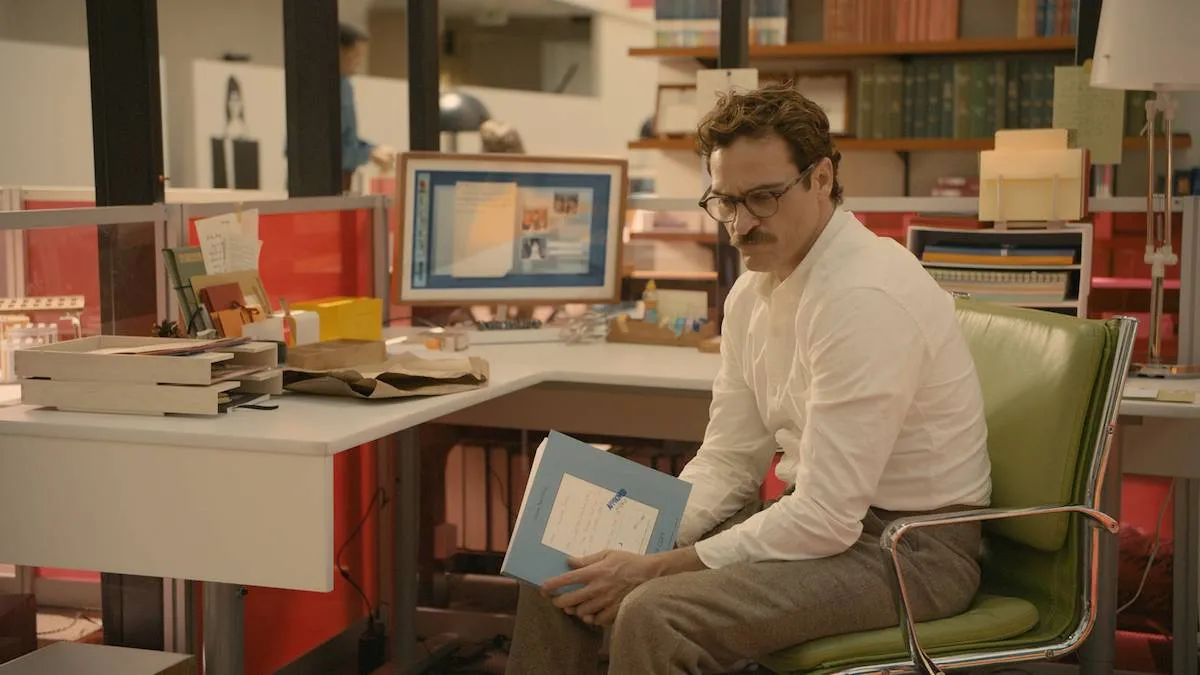
Theodore, the protagonist, is a professional ghostwriter. People no longer have the time or ability to write letters themselves, so they outsource the process to a company that crafts artificial handwritten letters for them. Customers send the service some information about the recipient and a few photos, and the writers dictate the text to a program that digitally mimics human handwriting. The social custom of handwritten letters is still present, but many people in the movie have lost the ability to communicate with others.
Many people are currently using AI to do tasks for them, like reading, writing, coding, research, and creative work. These are activities that require some brain work to accomplish, yet we seem perfectly happy to outsource them to an algorithm. Why? Because it’s faster, requires less effort, and, most importantly, doesn’t require developing or maintaining specific skills to create content.
AI companies are amassing huge investments while running at a loss. Their value proposition is to replace human intelligence. Their technology is not only designed to help us get better at something, but to do the work for us. They are betting that, sooner or later, AI will become essential to so many activities that we will all be willing to pay for it.
Another thing we can infer from the current state of AI is that it is designed to be used in isolation. This is not completely new. We saw social media platforms being built in much the same way. With AI, every conversation happens between the user and the model. Everyone uses their own personalised account and, because of how these models work, gets a slightly different answer.
What incentives are left to communicate with others, now that AIs are meant to have all the answers we need? If we believe the marketing claims, not many. There’s no limit to how many agents we can run in parallel, so many brave people can now become lone wolves, seeking personal success with low effort. We won’t need to rely on colleagues, teachers, mentors, friends, or experts for ideas and help. AI can provide both for us. Communicating with other humans might be seen as a time sink, as friction that slows us down from getting what we want as fast as possible.
A conversation with an AI is in theory like having a conversation with most of the knowledge that humanity has accumulated throughout history thanks to human collaboration. The combination of science, discoveries, books, art, customs and traditions, religions, cultures, digitised and loaded into a large neural network. Paradoxically, this knowledge is now offered into a boxed format, to be consumed individually, in isolation.
We’ve determined that two forces are at play: people are outsourcing their creativity and their ability to express themselves to algorithms, and they have less reasons to talk to each other. Combined, these two forces will soon make it even harder to connect with other humans. We will spend most of our time talking to AIs in isolation. Similarly to the protagonist in Her.
This will mostly happen if we don’t actively try to keep real communication in place. We can do that by writing things ourselves, by talking to people, and by expressing our thoughts using only our own words. As with everything, it’s up to us to choose what matters, but knowing the consequences can help us make smarter choices.